
In Bob Fosse’s 1979 film All That Jazz, there’s a scene that has stayed with me for years.
Joe Gideon, Fosse’s alter ego, played by Roy Scheider, wakes up already exhausted. Eye drops. Alka-Seltzer. A cigarette before his feet hit the floor. The camera holds on it all, unglamorous and a little brutal.
Then he looks in the mirror, slaps his own face twice, and says the line:
It’s showtime, folks.
The transformation is instant. By the time he walks out the door, the exhausted man in the mirror has been replaced by the electric, magnetic director the world expects to see.
I have thought about that scene many times over my career, not because I relate to the self-destruction of Gideon’s life, but because of the gap it captures.
There’s the version of us we assemble for the room, and then there’s the version nobody sees getting ready.
The Leader You Are When No One Is Watching
Most leaders have a showtime face. Fewer have thought about what happens in the hours when there’s no mirror, no audience, and no cue to perform.
We prepare intensely for the moments when leadership is visible: the board presentation, the all-hands meeting after a layoff, the client call where the deal is on the line.
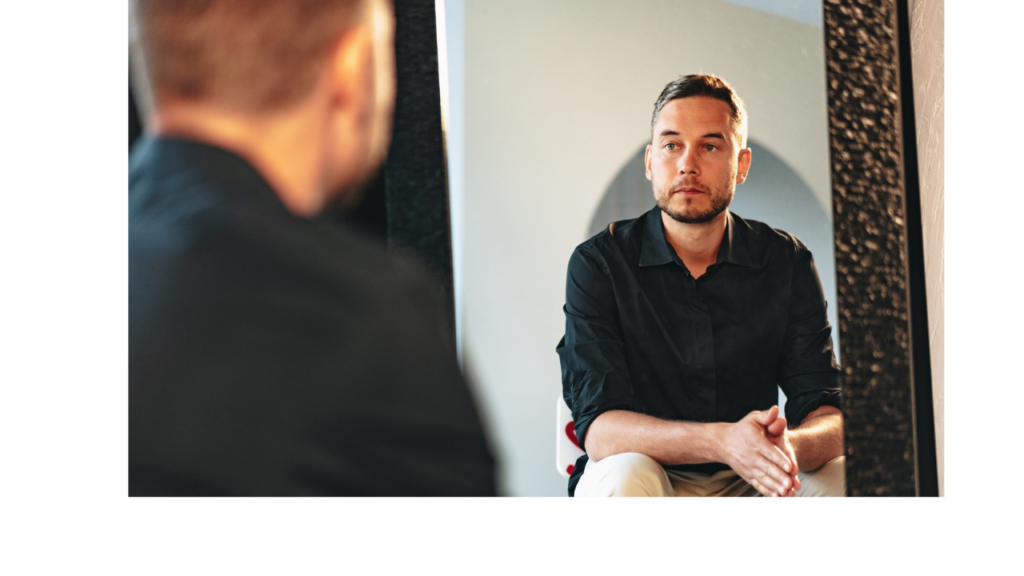
But some of the decisions that matter most to an organization’s future happen when nobody is watching.
Every executive I coach can tell me how they prepare for the moments when their leadership is most visible. They can describe their breathing, their pacing, the deliberate pause before answering a hard question. They’ve trained for those moments, and it shows.
Ask the same executive how they show up on a Tuesday afternoon, alone, working on something with no audience and no immediate payoff, and the story often changes.
I recognize this in my own work.
Coaching sessions get my full attention without effort. I don’t think about my next question until the client has finished sharing their thoughts. Before every session, I take a few minutes to get centered and ask myself one question:
How can I best serve this person today?
That’s easy, partly because coaching is my purpose, and partly because the feedback is immediate. I can usually tell what is resonating—the question that lands, the shift in perspective, the response that tells me something has connected.
Business development is where the test shows up for me.
Writing a proposal, following up on a lead—none of it rewards me the way a good coaching session does. So I switch tasks. I reorganize my inbox instead of finishing the draft.
A morning that should produce one finished piece of work produces three half-started ones, and a strong sense of having been busy.
It can be easy to frame this as a productivity challenge. But I think it’s more than that; it’s a leadership problem.
Neuroscience gives us a clue about why this happens. And understanding what’s happening underneath can give us more choice about what we do on the outside.
When we’re deciding whether to do something, our brains are weighing the value of the outcome against the effort required to get there. Dopamine is part of that equation, particularly when it comes to motivation and effort.
When a payoff is immediate and visible, the connection between effort and outcome is more obvious. When the payoff is distant, uncertain, or invisible, the work can have less motivational pull.
The work may be objectively important while still losing the competition for our attention.
That’s why some of the most consequential work leaders do is also some of the easiest to postpone.
Succession planning doesn’t produce an immediate win. Culture work rarely has a defined finish line.
You can mentor someone for years before you see the impact.
Strategic thinking can feel downright unproductive when there are emails waiting.
Yet these are precisely the activities that shape an organization’s future.
That is where I think the real leadership test begins.
Catching the Drift
I’ve stopped trying to solve this with willpower. Instead, I build structure around the work that doesn’t naturally pull me toward it.
At the start of the day, I consciously choose what matters most instead of defaulting to whatever’s loudest. During the day, I periodically ask whether my attention is where I intended it to be.
Sometimes, it isn’t.
That’s fine.
The goal isn’t perfect focus. It’s catching the drift before three hours disappear.
When I notice myself avoiding something, I don’t treat the resistance as proof that the work doesn’t matter. I treat it as information.
Then I ask:
What happens if I keep avoiding this—not today, but six months from now?
That question reconnects an unrewarding task to a consequence I care about.
Leaders already know how to prepare for showtime. We rehearse presentations. We prepare talking points. We practice difficult conversations. We regulate our breathing before walking into the room.
What if we gave the same attention to the invisible work?
The strategic thinking. The mentoring. Following through on something that’s been sitting on the list for weeks. The difficult decision we’ve been avoiding.
Not because someone is watching, but because we know it matters.
No one grades the Tuesday afternoon.
There’s no mirror, no slap, no line to deliver.
But those unwitnessed hours accumulate. The strategy doesn’t get finished. The relationship doesn’t get nurtured. The succession plan stays on the someday list. And over time, where we choose to put our attention shapes who we are when the curtain goes up.
Gideon’s tragedy was that showtime became the only version of himself he knew how to sustain.
The leadership test isn’t how well you perform when everyone’s watching.
It’s who you are in the hours before the slap.
Discover more from Margo Boster
Subscribe to get the latest posts sent to your email.